
Alfalfa County Court Records After Arrest
Alfalfa County court records after arrest are handled through the District Court system, not through a jail roster. The sheriff can confirm local custody or booking information when public release is allowed. The court record begins when a case is filed and maintained by the Court Clerk. The local Alfalfa County Court Clerk is Tammi Miller, located at 300 S. Grand, Suite 8, Cherokee, OK 73728. The office phone is 580-596-3523, the email is tammi.miller@oscn.net, and posted hours are 8:30 - 4:30, open at noon.
The District Attorney decides what criminal charges to file after law enforcement reports are reviewed. The county site lists District Attorney Christopher Boring and Assistant District Attorney Jeremy Bays for the district serving Alfalfa, Dewey, Major, Woods, and Woodward Counties. The DA office is in Suite 7 at the courthouse, phone 580-596-3109, with posted hours of 8:30 a.m. to 4:30 p.m. and closed at noon. The DA's filed complaint or information controls the formal charge record, even when the jail booking label used different words. Current custody and booking details belong with Alfalfa County jail inmate records, while booking-photo questions belong with Alfalfa County jail mugshots.
The official court clerk page is a useful source because it names the office that maintains permanent District Court records, dockets, filed transcripts, and court costs. The official Alfalfa County Court Clerk page is shown here as the local court-record source for filed cases.
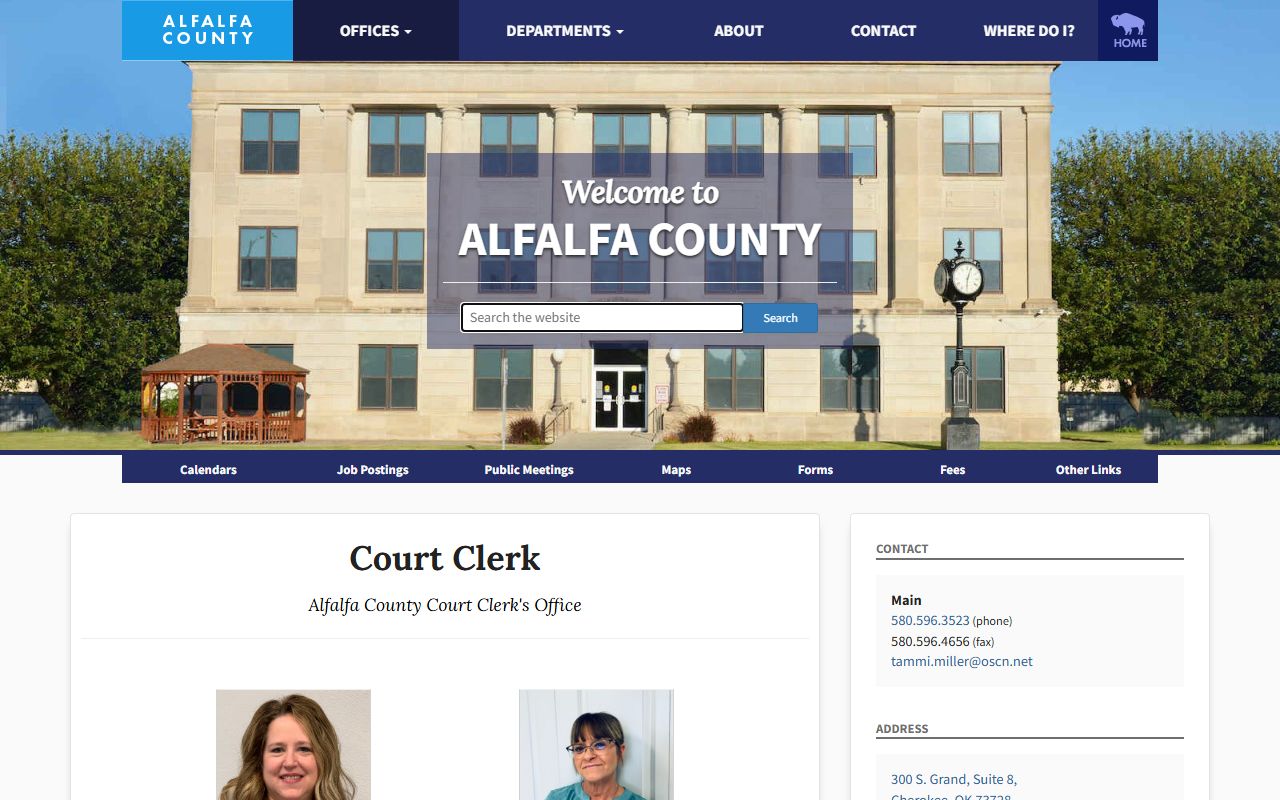
Use that local office for clerk-held case records, then use ODCR or OSCN when a public online docket is available.
Find Court Records After Jail Arrest
The usual path is arrest, booking, first appearance, prosecutor review, filed charge, docket entries, and disposition. If the arrest is very recent, a court case may not appear yet. Confirm custody or release with the sheriff, then search the court systems by defendant name or case number. ODCR's search page lists Alfalfa as a court option, and OSCN provides another Oklahoma docket search route.
- Confirm the recent arrest or release status with the Alfalfa County Sheriff's Office if timing is urgent.
- Search ODCR by court, party name, case type, case number, filed date, or activity date.
- Try OSCN docket search if ODCR does not show the case or if another Oklahoma court may hold the record.
- Open the docket and compare the filed charge, status, bond entry, warrant entry, and next court date.
- Call the Court Clerk if the case is sealed, too new to show, hard to match, or missing a document needed for inspection.
The ODCR interface is a strong match for Alfalfa County court-record searches because it shows the kind of fields used to find court records after a jail arrest. The ODCR search page appears below with search options that include court, party name, case type, case number, and date fields.
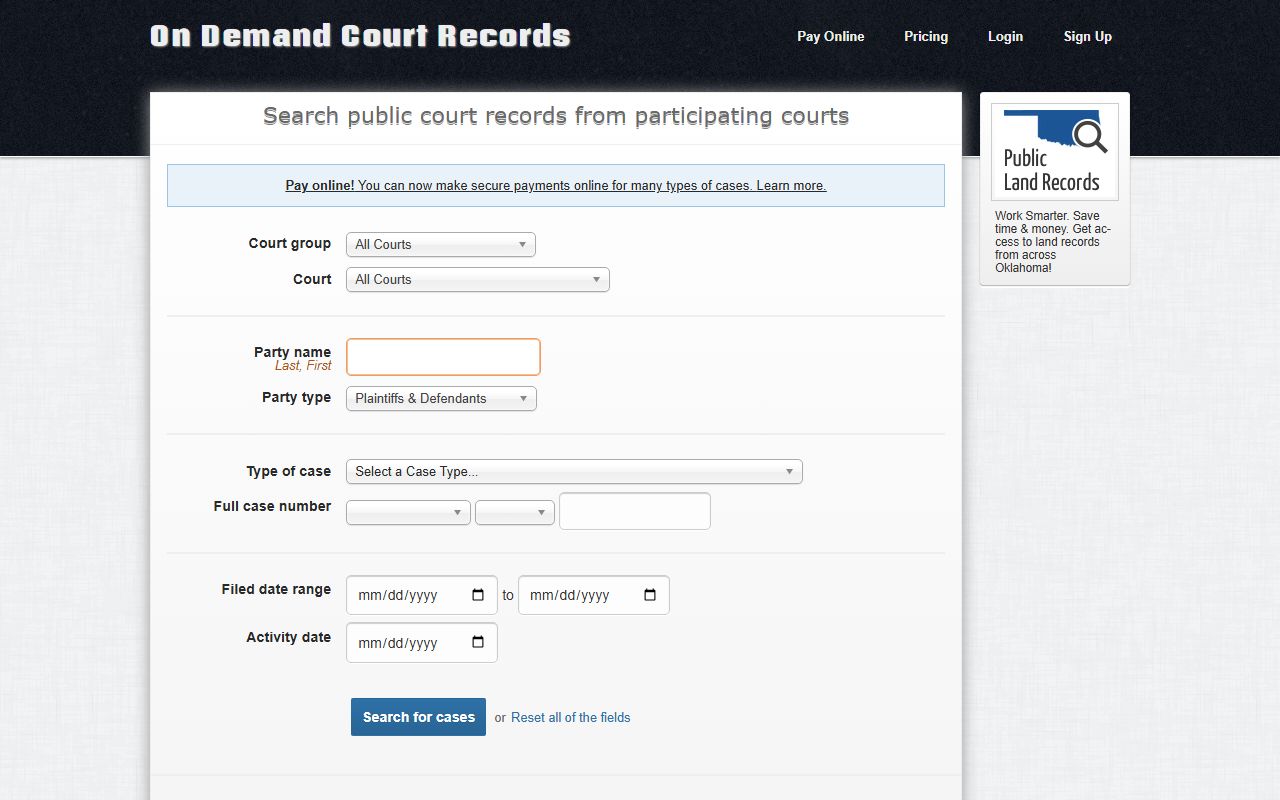
Those fields are most useful after the prosecutor has filed a case or the court has opened a docket entry.
Alfalfa County Court Search Fields
ODCR provides more search structure than the local jail does. That distinction matters. The county jail has no public online roster found in the research, while court cases can be searched once they exist in ODCR or OSCN. A search by last name may return several records, so use dates, case type, case prefix, or the court clerk's case number when known.
| Field Label | Type | Required | Options / Format Notes |
|---|---|---|---|
| Court group | Dropdown | Optional | All Courts, Oklahoma District Courts, or Tribal Courts. |
| Court | Dropdown | Optional | Includes Alfalfa and many other Oklahoma courts. |
| Party name | Text | Optional | ODCR labels the format as Last, First. |
| Party type | Dropdown or radio | Optional | Plaintiffs and defendants, or all parties. |
| Type of case | Dropdown | Optional | Includes criminal felony, misdemeanor, probable cause, search warrant, and traffic categories. |
| Full case number | Segmented fields | Optional | Common criminal prefixes include CF, CM, TR, and SW, but use the exact docket prefix. |
| Filed date range | Date fields | Optional | Useful when the arrest date is known. |
| Activity date | Date field | Optional | Limits by recent docket activity. |
Charges Filed After Arrest
After an Alfalfa County arrest, the jail may hold a person on arrest allegations, a warrant, a detainer, or another agency's hold. The court record becomes more precise when the prosecutor files a charging document. That filing can change the label, count, severity, or status from what family members heard at booking. A complaint, information, or indictment is not a conviction. It is the formal accusation that starts or shapes the court case.
| Document | Who Files It | How It Functions |
|---|---|---|
| Complaint | Officer or prosecutor depending on case posture | Often begins the criminal case or supports probable cause. |
| Information | District Attorney | Common prosecutor-filed charging document for Oklahoma felony or misdemeanor cases. |
| Indictment | Grand jury | Grand-jury accusation used in serious or specially reviewed matters. |
The court record should be read count by count. A case can have one arrest, several counts, later amendments, dismissed counts, and a different final disposition for each count. When a charge affects bond or release, confirm with the sheriff and the court rather than relying on an old booking label.
Alfalfa County Charge Status
Charge status words describe where a case stands. They do not always state what happened at arrest. A pending count has not been disposed. An amended count may have changed wording or level. A dismissed count ended without conviction on that charge. A deferred disposition can lead to dismissal if conditions are met, while a suspended sentence is still tied to a conviction unless the docket shows otherwise. Read the court record closely and ask the clerk if a docket abbreviation is unclear.
| Status | What It Means |
|---|---|
| Pending | Filed charge remains open and has not reached final disposition. |
| Amended | Prosecutor changed the charge language, level, or count. |
| Reduced | Charge was lowered or resolved as a lesser offense. |
| Dismissed | Count or case ended without a conviction on that charge. |
| Deferred | Disposition may end in dismissal if court-ordered conditions are completed. |
| Conviction | Final guilt finding or plea, distinct from arrest or filing alone. |
Bond After Alfalfa County Arrest
No Alfalfa County jail bond page was located. Bond should be treated as court controlled and case specific. The Court Clerk page links to Oklahoma fee and bond schedules through OSCN, while the sheriff is the practical office to confirm whether a person is physically in custody and whether any hold blocks release. A bond amount in a court record does not always mean the person can leave at once. Processing time, warrant checks, detainers, federal holds, ICE issues, or DOC holds can delay or prevent release.
| Bond or Hold Type | How It Works |
|---|---|
| Cash bond | Full required amount is paid in an accepted form to secure appearance. |
| Surety bond | A licensed bondsman posts bond for a fee and guarantees appearance. |
| Personal recognizance | Release on promise to appear and follow court conditions. |
| Property bond | Property may secure the bond if allowed and accepted by the court. |
| No-bond hold | No ordinary release until a judge changes the order or another agency clears the hold. |
| Detainer | Another agency asks the jail to hold or transfer the person. |
Verify bond first with the sheriff at 580-596-3269, then check ODCR, OSCN, or the Court Clerk for filed court entries. Ask about accepted payment forms before travel because the official county pages do not publish jail bond payment methods.
Warrants and Court Records
The sheriff page does not publish an active warrant search or most-wanted list. It does state that the sheriff serves warrants and District Court papers. For Alfalfa County court records after an arrest on a warrant, search ODCR or OSCN by name and case number, then contact the sheriff or court clerk to confirm service status. Bench warrants often arise from failure to appear or violation of a court order. Search warrant cases may appear under separate case-type categories.
- Arrest warrant
- A judge's order to take a person into custody.
- Bench warrant
- A judge-issued warrant, often tied to failure to appear.
- Search warrant
- Authority to search a person, place, or property.
- Fugitive hold
- A request from another jurisdiction seeking custody.
Note: A warrant-related booking can have both a jail record and a court record, but each office controls its own file.
Charges vs Convictions
A charge is an accusation. A conviction is a final guilt finding or plea. Public court records after a jail arrest may show both, but the difference matters for employment, housing, immigration, voting rights, sentencing, and expungement questions. Do not read an arrest, booking charge, or pending count as proof that a person was convicted.
| Point | Charge | Conviction |
|---|---|---|
| Stage | Accusation filed after arrest or investigation. | Final plea, verdict, or finding of guilt. |
| Proof | Based on probable cause and prosecutor filing. | Requires a plea or proof beyond a reasonable doubt. |
| Can change | May be amended, reduced, or dismissed. | May be appealed, modified, or later affected by expungement. |
Sealed and Expunged Records
Oklahoma expungement rules can affect both arrest and court records. The OSBI expungement page explains Section 18 and 991(c) paths and notes a $150 OSBI processing fee for arrest-record expungement. A Section 18 expungement can seal an entire arrest record when eligibility is met. A 991(c) update changes a deferred-sentence disposition but does not remove the arrest record. Expunging a court record is separate from changing every law-enforcement, OSBI, or agency-held record.
| Record Issue | Sealed | Expunged / Updated |
|---|---|---|
| Public visibility | Hidden or limited from public view after court order. | Treated according to the specific Oklahoma expungement or update order. |
| Arrest record | May remain unless the order reaches the arrest agency and OSBI record. | Section 18 can address full arrest-record sealing when eligible. |
| Deferred sentence | May be reflected in docket language. | 991(c) affects the deferred disposition but not the arrest itself. |
Restricted Court Records After Arrest
Not every court record after a jail arrest is public in full. Juvenile records, sealed cases, expunged matters, victim information, protected identifiers, confidential medical or mental-health details, and active investigative material may be withheld or redacted. Oklahoma's Open Records Act opens many public records, but it also allows limits where another law requires confidentiality. If a case is not visible online, the reason may be timing, spelling, court selection, sealing, juvenile status, or a record held outside ODCR and OSCN.
Important: Public court lookups are not FCRA background checks and should not be used for employment, credit, tenant, insurance, or similar screening decisions.